Buy leadgeneration.eu ?
We are moving the project
leadgeneration.eu .
Are you interested in purchasing the domain
leadgeneration.eu ?
domain@kv-gmbh.de · 0541-91531010
Buy leadgeneration.eu ?
What is a finite automaton?
A finite automaton is a mathematical model used to represent a system that processes input and transitions between different states based on that input. It consists of a set of states, a set of input symbols, a transition function that specifies how the automaton moves from one state to another based on the input, a start state, and a set of accepting states. Finite automata are used in computer science and theoretical computer science to model and analyze the behavior of systems that can be in a finite number of states and transition between them based on input. They are used in various applications such as lexical analysis in compilers, pattern matching in text processing, and modeling of digital circuits. **
How do you create a deterministic finite automaton from a non-deterministic pushdown automaton?
To create a deterministic finite automaton (DFA) from a non-deterministic pushdown automaton (PDA), we can use the subset construction method. This involves creating a state in the DFA for each possible combination of states in the PDA. The transitions in the DFA are determined by simulating the behavior of the PDA on each input symbol. If the PDA can be in multiple states at a given time, the DFA will have a state for each combination of those states. The final states of the DFA are determined by whether any of the PDA's possible states are final states. This process results in a deterministic finite automaton that simulates the behavior of the original non-deterministic pushdown automaton. **


Similar search terms for Automaton
Top-Angebote
Products related to Automaton:
-
Econoco Vintage Pipeline Adjustable Rolling Garment Rack"42"" wide Hangrail - Adjusts from 44"" - 72"" in height. Base: 42-1/2""W x 23-3/8""D. Constructed of heavy duty 1 1/4"" diameter plumbing pipe in anthracite grey finish. Includes four 3"" casters, 2 locking, 2 non-locking."277,99 $*Shipping: 0,00 $Secure redirect to the provider
-
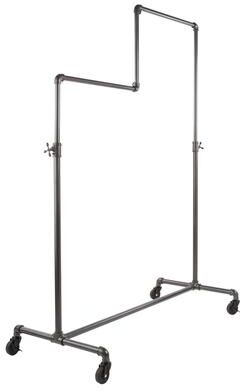
Econoco Pipeline Adjustable 2 Way Cross Bar Rack"Adjusts from 44"" - 72"" in height. Base: 21""W x 21""D with 13"" Faceouts. Constructed of heavy duty 1 1/4"" diameter plumbing pipe in anthracite grey finish. Includes four 2"" casters, 2 locking, 2 non-locking. The Pipeline collection is a uniquely..."236,99 $*Shipping: 0,00 $Secure redirect to the provider



-
How do you enter the state transition diagram of an automaton into an automaton table?
To enter the state transition diagram of an automaton into an automaton table, you first list all the states of the automaton as rows in the table. Then, list all the input symbols as columns in the table. For each state and input symbol pair, fill in the corresponding cell with the next state that the automaton transitions to. Repeat this process for all state and input symbol pairs until the entire transition diagram is represented in the automaton table. **
-
How do you transfer the state transition diagram of an automaton into an automaton table?
To transfer the state transition diagram of an automaton into an automaton table, you need to list all the states of the automaton as rows in the table. Then, list all the input symbols as columns in the table. Fill in the table with the corresponding next state for each combination of current state and input symbol based on the transitions in the state transition diagram. Finally, indicate the initial state and any final states in the table. This table can then be used to simulate the behavior of the automaton for different input sequences. **
-
How does a deterministic finite automaton (DFA) work?
A deterministic finite automaton (DFA) is a mathematical model used to recognize patterns in strings of symbols. It consists of a finite set of states, a finite set of input symbols, a transition function that maps a state and an input symbol to another state, a start state, and a set of accepting states. The DFA starts in the start state and reads input symbols one at a time, transitioning between states according to the transition function. Once the input is fully processed, the DFA is in a final state, and if that state is an accepting state, the input is accepted; otherwise, it is rejected. DFAs are used in various applications, such as lexical analysis in compilers and pattern matching in text processing. **
-
How does a non-deterministic finite automaton work?
A non-deterministic finite automaton (NFA) is a theoretical model of computation that consists of a set of states, a set of input symbols, a transition function, an initial state, and a set of accepting states. Unlike a deterministic finite automaton (DFA), an NFA can have multiple possible transitions from a given state on a given input symbol. When processing input, an NFA can be in multiple states simultaneously and can transition to multiple states at once. It accepts a given input string if there exists at least one path through the states that leads to an accepting state. NFAs are often used in theoretical computer science to model certain types of computations and are a key concept in the theory of formal languages and automata. **


What is a cellar automaton in theoretical computer science?
A cellar automaton is a type of cellular automaton in theoretical computer science. Cellular automata are discrete models studied in computer science and mathematics, consisting of a grid of cells, each of which can be in a finite number of states. The state of each cell evolves over time according to a set of rules based on the states of neighboring cells. In a cellar automaton, the grid is arranged in a three-dimensional lattice, and the state of each cell is updated based on the states of its six neighboring cells. Cellar automata are used to study complex systems and emergent behavior in various fields, including physics, biology, and computer science. **
What is a deterministic finite automaton in computer science?
A deterministic finite automaton (DFA) is a type of finite state machine in computer science. It consists of a set of states, a set of input symbols, a transition function that maps states and input symbols to other states, a start state, and a set of accepting states. DFAs are used to recognize patterns in input strings by transitioning between states based on the input symbols. They are simpler than nondeterministic finite automata (NFAs) as they have a unique transition for each input symbol in each state. **
Top-Angebote
Products related to Automaton:
-
L'Oreal 16 oz Mega Moisture Nurturing Creme 16 OzL'Oreal's Mega Moisture Nurturing Creme unique formula tames unruly hair with intense moisture, making it flexible, easy to manage and able to hold your style in place. It can be used for everyday conditioning or even longer, deep conditioning,...24,19 $*Shipping: 0,00 $Secure redirect to the provider
-
Uplifted Finds Predatory Engagement Wrestling Puppet Hub Predatory Engagement Wrestling Puppet HubTransform interactive play with the PredatoryEngagement Puppet, a professionalgrade interaction module engineered with manualsimulation logic. This highutility tool features a reinforced plush architecture and poseable limbs, specifically designed...85,97 $*Shipping: 0,00 $Secure redirect to the provider
-
Econoco Vintage Pipeline Adjustable Rolling Garment Rack"42"" wide Hangrail - Adjusts from 44"" - 72"" in height. Base: 42-1/2""W x 23-3/8""D. Constructed of heavy duty 1 1/4"" diameter plumbing pipe in anthracite grey finish. Includes four 3"" casters, 2 locking, 2 non-locking."277,99 $*Shipping: 0,00 $Secure redirect to the provider
-
What is a finite automaton?
A finite automaton is a mathematical model used to represent a system that processes input and transitions between different states based on that input. It consists of a set of states, a set of input symbols, a transition function that specifies how the automaton moves from one state to another based on the input, a start state, and a set of accepting states. Finite automata are used in computer science and theoretical computer science to model and analyze the behavior of systems that can be in a finite number of states and transition between them based on input. They are used in various applications such as lexical analysis in compilers, pattern matching in text processing, and modeling of digital circuits. **
-
How do you create a deterministic finite automaton from a non-deterministic pushdown automaton?
To create a deterministic finite automaton (DFA) from a non-deterministic pushdown automaton (PDA), we can use the subset construction method. This involves creating a state in the DFA for each possible combination of states in the PDA. The transitions in the DFA are determined by simulating the behavior of the PDA on each input symbol. If the PDA can be in multiple states at a given time, the DFA will have a state for each combination of those states. The final states of the DFA are determined by whether any of the PDA's possible states are final states. This process results in a deterministic finite automaton that simulates the behavior of the original non-deterministic pushdown automaton. **
-
How do you enter the state transition diagram of an automaton into an automaton table?
To enter the state transition diagram of an automaton into an automaton table, you first list all the states of the automaton as rows in the table. Then, list all the input symbols as columns in the table. For each state and input symbol pair, fill in the corresponding cell with the next state that the automaton transitions to. Repeat this process for all state and input symbol pairs until the entire transition diagram is represented in the automaton table. **
-
How do you transfer the state transition diagram of an automaton into an automaton table?
To transfer the state transition diagram of an automaton into an automaton table, you need to list all the states of the automaton as rows in the table. Then, list all the input symbols as columns in the table. Fill in the table with the corresponding next state for each combination of current state and input symbol based on the transitions in the state transition diagram. Finally, indicate the initial state and any final states in the table. This table can then be used to simulate the behavior of the automaton for different input sequences. **
Similar search terms for Automaton
-
Econoco Pipeline Adjustable 2 Way Cross Bar Rack"Adjusts from 44"" - 72"" in height. Base: 21""W x 21""D with 13"" Faceouts. Constructed of heavy duty 1 1/4"" diameter plumbing pipe in anthracite grey finish. Includes four 2"" casters, 2 locking, 2 non-locking. The Pipeline collection is a uniquely..."236,99 $*Shipping: 0,00 $Secure redirect to the provider
-
John Blake Peaky Blinders: The Legacy - The real story of Britains most notorious 1920s gangs: The follow-up to the Sunday Times BestsellerThe Peaky Blinders as we know them, thanks to the hit TV series, are infused with drama and dread. Fashionably dressed, the charismatic but deeply flawed Shelby family have become cult anti-heroes. Well-known social historian, broadcaster and author, Carl Chinn, revealed the true story of the notorious gang in his bestselling Peaky Blinders: The Real Story and now in this follow-up book, he explores the legacy they created in Birmingham and beyond. What happened to them and their gangland rivals? In Peaky Blinders: The Legacy we revisit the world of Billy Kimber's Peaky Blinders, exploring their legacy throughout the 1920s and 30s, and how their burgeoning empires spread across the UK. Delve into the street wars across the country, the impact of the declaration of War on Gangs by the Home Secretary after The Racecourse War in 1921, and how the blackmailing of bookmakers gave way to new and daring opportunities for the likes of Sabini, Alfie Solomon and some new faces in the murky gangland underworld. Drawing on Carl's inimitable research, interviews and original sources, find out just what happened to this incredible cast of characters, revealing the true legacy of the Peaky Blinders.3,99 £*Shipping: 1,99 £Secure redirect to the provider
-
Econoco Pipeline Adjustable Double Bar Box Rack, Anthracite Grey"Base dimensions measure 48""L x 22""W. Hangrails measure approximately 60"" long and have a 1"" dia. Double hangrails adjust independently from approximately 53-1/2""H to 80""H. Base is constructed of 1-1/4"" dia. pipe."367,91 $*Shipping: 0,00 $Secure redirect to the provider
-
How does a deterministic finite automaton (DFA) work?
A deterministic finite automaton (DFA) is a mathematical model used to recognize patterns in strings of symbols. It consists of a finite set of states, a finite set of input symbols, a transition function that maps a state and an input symbol to another state, a start state, and a set of accepting states. The DFA starts in the start state and reads input symbols one at a time, transitioning between states according to the transition function. Once the input is fully processed, the DFA is in a final state, and if that state is an accepting state, the input is accepted; otherwise, it is rejected. DFAs are used in various applications, such as lexical analysis in compilers and pattern matching in text processing. **
-
How does a non-deterministic finite automaton work?
A non-deterministic finite automaton (NFA) is a theoretical model of computation that consists of a set of states, a set of input symbols, a transition function, an initial state, and a set of accepting states. Unlike a deterministic finite automaton (DFA), an NFA can have multiple possible transitions from a given state on a given input symbol. When processing input, an NFA can be in multiple states simultaneously and can transition to multiple states at once. It accepts a given input string if there exists at least one path through the states that leads to an accepting state. NFAs are often used in theoretical computer science to model certain types of computations and are a key concept in the theory of formal languages and automata. **
-
What is a cellar automaton in theoretical computer science?
A cellar automaton is a type of cellular automaton in theoretical computer science. Cellular automata are discrete models studied in computer science and mathematics, consisting of a grid of cells, each of which can be in a finite number of states. The state of each cell evolves over time according to a set of rules based on the states of neighboring cells. In a cellar automaton, the grid is arranged in a three-dimensional lattice, and the state of each cell is updated based on the states of its six neighboring cells. Cellar automata are used to study complex systems and emergent behavior in various fields, including physics, biology, and computer science. **
-
What is a deterministic finite automaton in computer science?
A deterministic finite automaton (DFA) is a type of finite state machine in computer science. It consists of a set of states, a set of input symbols, a transition function that maps states and input symbols to other states, a start state, and a set of accepting states. DFAs are used to recognize patterns in input strings by transitioning between states based on the input symbols. They are simpler than nondeterministic finite automata (NFAs) as they have a unique transition for each input symbol in each state. **
* All prices are inclusive of VAT and, if applicable, plus shipping costs. The offer information is based on the details provided by the respective shop and is updated through automated processes. Real-time updates do not occur, so deviations can occur in individual cases. ** Note: Parts of this content were created by AI.